
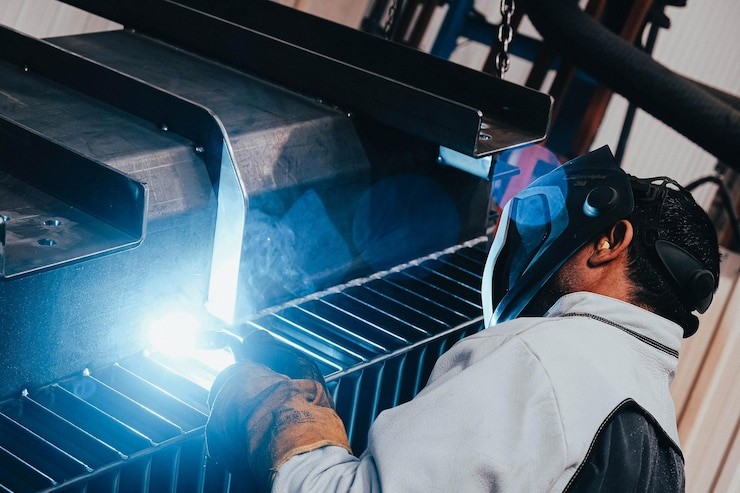
Strong welds don’t just hold metal—they hold trust. When you’re relying on your trailer to carry weight across fields, farms, and factory yards, weak joints aren’t an option. That’s why custom MIG welding for trailer parts is fast becoming the go-to standard for strength, reliability, and long-lasting performance in frame construction. If you’ve ever wondered what separates a tough trailer from a ticking time bomb, you’re about to find out.
MIG welding—short for Metal Inert Gas welding—delivers what every trailer frame demands: clean, deep, and consistent welds. Whether you’re hauling heavy farming implements or transporting industrial machinery, the structural integrity of your trailer starts with how it’s welded.
Unlike other welding methods, MIG allows for continuous wire feeding, which results in fewer start- stop marks, less splatter, and deeper penetration at key stress points. That means more strength where you need it most.
Did you know? According to the American Welding Society, over 50% of trailer failures occur at weld joints—usually due to weak or uneven welds. This makes precision MIG work a necessity—not a luxury—for your trailer’s durability.
Some areas on a trailer simply cannot afford failure. And that’s where custom MIG welding for trailer parts shines brightest. Here’s where MIG welds truly prove their worth:
● Hitch connections – enduring constant vibration and load stress
● Axle mounts – handling uneven terrain and shifting weight
● Crossmembers – supporting cargo and reducing frame flex
● Tongue joints – often the first to bear the brunt of turns and brakes
A traditional stick weld just won’t cut it in these high-stress locations. You need welds that bind with depth and clarity—exactly what MIG offers.
| Component | Stress Type | MIG Welding Advantage |
| Hitch Assembly | Load-bearing, vibration | Smooth, continuous welds resist fatigue |
| Frame Crossmembers | Flex & torque | Deep penetration ensures structure |
| Axle Brackets | Impact, ground contact | Strong bonding reduces break risk |
| Trailer Tongue | Torsion from turning | Clean edges lower risk of crack spread |
| Load Support Rails | Weight shifts, tilt | Weld uniformity improves distribution |
At a time when trailers are expected to do more and last longer, not just any welding will do. You need a team that understands how different metals behave, how field conditions affect weld stress, and how precision welding prevents frame fatigue.
That’s where a custom trailer frame fabrication shop like Denning Machine Shop Inc steps in. With in-house MIG welding capabilities, shear & brake operations, machine work, and specialized parts manufacturing, Denning has the range of tools and experience to build to spec and build to last.
You might be surprised at what’s holding your trailer together right now. Have you inspected your welds lately? Are they up to the mark for what your equipment faces day in, day out?
Your welds are either your trailer’s strength or its weakest link.
Here’s where it gets real. Poor welding can lead to catastrophic failures—not just structural but operational. A cracked frame in the middle of harvest season or during industrial transport can grind productivity to a halt. Worse still, it can put safety at serious risk.
But with custom MIG welding for trailer parts, you gain a critical edge: reliability over time, even under pressure.
Let that sink in. One poor weld could mean downtime, damage, or even danger. But one strong weld—done right—can keep your operations running smooth for years.
Whether it’s rough farm terrain, industrial weight, or seasonal wear and tear, your trailer will face the grind. So the question is—will it hold up?
Denning Machine Shop Inc, with its range of options, is here to cater to all your requirements. From MIG welding to precision machine work, your trailers—and your business—are in good hands.
So, what kind of weld is holding up your future?